When play is moving, timing matters. Fluency-Based Instruction (FBI) is a key component of our ABA staff training methods, helping our teams learn key procedures quickly and use them accurately in session. Think of it as precision teaching through “short practice sprints” that build speed and confidence, so children get more high-quality learning moments and fewer “do-overs.”
Using fluency-based instruction
Short, timed practice. Team members rehearse the exact steps of a Behavior Support Plan for brief intervals.
Clear goals. We track correct and incorrect responses per minute.
Feedback loops. Quick feedback between timings keeps practice efficient.
Back to the playroom. The goal isn’t test scores. It’s cleaner implementation in real sessions.
A quick story from the floor
“A new BT had a Behavior Support Plan to learn. We set up daily 1-minute timings with fill-in prompts, then checked her implementation in session. Before the study block, she was accurate on fewer steps. After the timings, accuracy improved, which freed her supervisor to focus on a few fine-tune items instead of the whole plan.”
We share this as a single-case example. Results vary by learner, program, and training history. Replication is ongoing.
The Proof
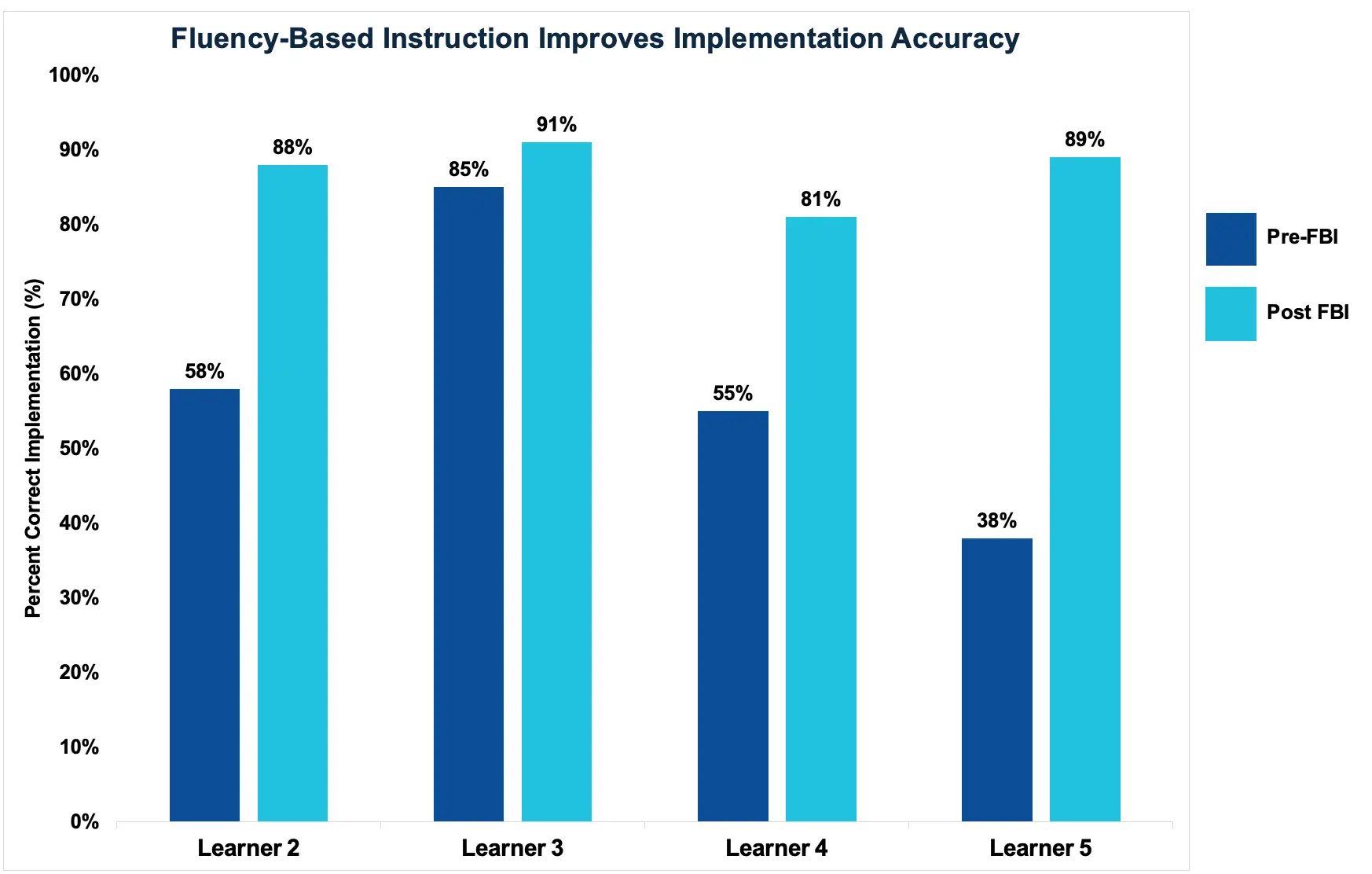
After introducing short fluency practice sprints, staff implementation of the target procedure improved steadily across learners. This chart compares percent correct implementation before and after fluency-based instruction, defined as the percentage of procedural steps completed as designed. Results illustrate how brief, targeted practice can lead to faster gains in consistency during real sessions.
Why families care
More teaching, less re-teaching. Clean implementation means more true learning opportunities.
Smoother sessions. Children experience fewer interruptions and faster momentum.
Faster handoffs. Supervisors can spend time on the few steps that still need shaping.
Not a replacement for supervision or role-play. It reduces the lift so supervisors can target what matters most.
Not a guarantee of outcomes. It supports fidelity, which supports outcomes.
FAQ: Fluency-Based Instruction
What is Fluency-Based Instruction?
Fluency-Based Instruction is an approach that teaches skills to accuracy and speed so the learner can use them quickly, effortlessly, and correctly in real life.
How would you use Fluency-Based Instruction?
Short, timed practice that helps team members learn the exact steps of a program quickly and use them accurately in session. Think efficient “practice sprints” that translate to cleaner implementation in the playroom.
Why does this matter for kids?
When implementation is clean, children get more high-quality learning moments and fewer do-overs. Sessions feel smoother and momentum builds.
What do you actually measure?
We track percent of steps implemented correctly, and correct and incorrect responses per minute to see if training is helping where it counts—during real sessions.
Does Fluency-Based Instruction replace supervision or role-play?
No. It lightens the lift so supervisors can focus on the few steps that still need shaping. It complements coaching rather than replacing it.
How fast does it work?
Timing varies by learner, program, and staff experience. The goal is steady improvement.
What does training look like?
Brief, timed practice (often a couple of minutes), quick feedback, make adjustments as needed, then back to session to apply it, always with the child’s experience in mind.
Is this guaranteed to improve outcomes?
No guarantees. Fluency-Based Instruction supports outcomes. We monitor data and continue to replicate successful approaches.
How do I learn more or get involved?
Families can connect with the Intake Team for services. Clinicians interested in research-friendly roles can explore opportunities through PEBBL.