Autism communication strategies matter most when your child reaches for something on the counter, looks you in the eye, and you realize the gap between what they want to say and what they can express is wider than any parenting book prepared you for. That moment, repeated dozens of times a day, is where real progress begins.
Autism communication strategies are structured, evidence-based approaches designed to help children with autism express their wants and needs through verbal and nonverbal means. These strategies range from simplifying your own language to introducing assistive technology, and they work best when woven into the everyday routines your child already knows. Whether your child is nonverbal, minimally verbal, or just beginning to use words, the seven strategies in this guide give you a clear starting point you can put into practice today.
Nonverbal, Minimally Verbal, and Nonspeaking: What Do These Terms Mean?
Before exploring specific strategies, it helps to understand how professionals describe different communication profiles. “Nonverbal” typically refers to children who do not use spoken words to communicate. “Minimally verbal” describes children who use a small number of words or word approximations, often inconsistently. “Nonspeaking” is a term many in the autism community prefer because it emphasizes that a child may understand language and communicate in other ways even without speech.
Research estimates that around 25 to 30 percent of children with autism are minimally verbal or nonspeaking. That is a significant number of families looking for practical guidance. The distinctions between these terms matter because they shape which strategies and tools fit your child’s current abilities and where you set your next goals.

7 Autism Communication Strategies That Build Connection Every Day
1. Use Simple, Literal Language
This strategy means reducing the number of words in your sentences and avoiding figurative expressions that children with autism may interpret at face value. Children who are nonverbal or minimally verbal process language more effectively when adults strip away extra words and keep meaning concrete.
At-home example: Instead of saying “Let’s go ahead and get your shoes on so we can head out the door,” try “Shoes on. Let’s go car.” Pair the short phrase with a gesture toward the shoes. Over time, this clear input gives your child a model they can begin to imitate or respond to with less confusion.
2. Allow Extra Processing Time
Extra processing time means pausing for 10 to 20 seconds after you speak, giving your child the space to understand your words and formulate a response. Many caregivers underestimate how long this feels in real time. Count silently. It will feel awkward at first, and that is completely normal.
At-home example: At snack time, hold up two options and say “Apple or crackers?” Then wait. Resist the urge to repeat the question or rephrase it. Your child may look between the two items, reach, vocalize, or point. Each of those responses is communication, and your patience made it possible.
3. Use Visual Supports Like Schedules and Communication Boards
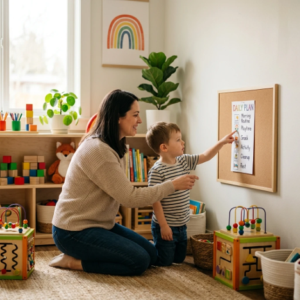
Visual supports are pictures, symbols, or written words displayed in a structured format to help children with autism understand expectations and express choices. These include visual schedules (step-by-step picture sequences of daily routines), choice boards (images of available options), and first-then boards that pair a less preferred activity with a motivating one.
At-home example: Create a simple morning routine board with three images in order: toilet, toothbrush, and breakfast plate. Attach the images with Velcro so your child can remove each one as they finish the step. This gives your child a sense of control and predictability. Families looking for more ways to promote autonomy in children diagnosed with autism often find visual support to be the single most impactful first step.
4. Try PECS (Picture Exchange Communication System)
PECS is a structured program where children learn to hand a picture card to a communication partner in exchange for the item or action shown on the card. Unlike passive visual supports, PECS requires your child to initiate communication, which builds a critical foundation for future social interaction.
At-home example: Start with a highly motivating item, like a favorite snack. Place a picture of that snack within your child’s reach. When they want it, physically guide them to pick up the card and hand it to you. Immediately give them the snack and label it: “Goldfish!” Over several sessions, fade your physical prompts so your child initiates the exchange independently. One honest caveat here: PECS works best when you learn the full six-phase protocol from a trained professional. Doing only phase one at home gives limited results.
5. Explore AAC and Speech-Generating Devices
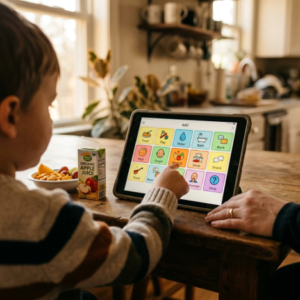
Augmentative and alternative communication (AAC) includes any tool or system that supplements or replaces spoken language. Low-tech AAC ranges from picture boards to simple voice-output buttons. High-tech AAC includes tablet-based apps and dedicated speech-generating devices that produce spoken words when your child selects icons on a screen.
A common concern among parents is that AAC will prevent their child from developing speech. Research consistently shows the opposite. AAC supports language development by giving children a reliable way to communicate while their verbal skills continue to grow. If your child is not yet using words consistently, an AAC evaluation from a speech-language pathologist can help determine which system matches their motor skills and daily communication needs.
At-home example: Download a free or low-cost AAC app on a tablet. Start with a board of four to six core words your child needs throughout the day: “more,” “stop,” “help,” “eat,” “play,” and “go.” Model by pressing the buttons yourself during natural activities. During play, press “more” before blowing another bubble. Your child begins to associate the button press with the outcome. For a deeper look at how speech services support this process, the resource on the importance of speech services for children diagnosed with autism outlines how professional guidance accelerates AAC learning.
6. Add Sign Language and Gestures
Teaching a small set of functional signs or gestures gives nonverbal or minimally verbal children a way to communicate without an external device. You do not need to learn full American Sign Language. Even five to ten signs for high-frequency needs can dramatically reduce frustration for both you and your child.
At-home example: Teach the sign for “more” during a preferred activity like swinging. Push your child on the swing, then stop. Model the sign by bringing your fingertips together. If your child makes any approximation of the sign, push the swing immediately. Pair the sign with the spoken word every time. Over days and weeks, the association strengthens, and your child gains a tool they can use across settings.
7. Build Functional Communication to Replace Frustration
Functional communication means teaching your child a specific, appropriate way to request what they need instead of relying on behaviors like crying or pulling your hand. This approach, rooted in Functional Communication Training (FCT), starts by identifying what your child is trying to communicate through their current behavior and then providing a more effective replacement.
This is the strategy that often has the most immediate impact on daily family life. When a child learns to request a break, ask for help, or say “all done” using any modality (spoken word, sign, picture card, or device), the need for the challenging behavior decreases because the communication need is being met.
At-home example: If your child throws materials during a difficult task, they may be communicating “I need a break.” Teach them to hand you a “break” card or press a “break” button on their device. Honor the request immediately at first, even if the break is brief. You are teaching them that communication works. For families seeking additional autism communication tips for families and friends, extending these strategies to grandparents and teachers ensures consistency across your child’s day.
Putting These Autism Communication Strategies into Practice at Home
The most common mistake parents make is trying all seven strategies at once. Start with one or two that match your child’s current abilities and your family’s daily routine. If your child already reaches or points, visual supports and PECS build on that existing strength. If your child responds well to imitation, sign language may be the fastest entry point.
Also, watch your own communication habits. Speaking too quickly and asking rapid-fire questions can unintentionally increase processing demands and shut down communication attempts. Slow down. Simplify. Wait. These adjustments alone, practiced consistently, create a communication-rich environment where children can thrive in a supportive, play-based setting.
Narrating your day out loud is another way to build language naturally. As you move through routines, describe what you are doing in short, consistent phrases, like “Washing hands. Water on. Soap on.” This kind of self-talk gives your child repeated exposure to the same words tied to the same actions. Repeating those phrases across days, rather than switching up the wording each time, helps functional language take root and become something your child can eventually use themselves.
You do not need a clinical degree to apply these principles. You need intentional practice during the moments you already share with your child: meals, bath time, play, and transitions. Responsive, communication-rich interaction woven into these everyday routines is what helps language grow over time.
Families often find that participating in a caregiver webinar on increasing communication skills in children with autism provides the coaching framework to stay consistent and troubleshoot when a strategy does not seem to be working.
Frequently Asked Questions
How can I track progress when my child is not using spoken words yet?
Focus on measurable behaviors such as increased initiations, clearer choice-making, and longer back-and-forth exchanges. A simple weekly log of what your child used (gesture, picture, or device) and in which situations can reveal patterns and growth over time.
What are the first steps to introduce a communication device without overwhelming my child?
Start by limiting the screen to a small set of highly useful words and keep the device available during predictable routines. Build interest by modeling short messages tied to immediate outcomes, then gradually expand vocabulary once your child consistently uses a few buttons.
How do I choose between pictures, signs, and AAC for my child?
The best fit depends on motor skills, sensory preferences, and how easily caregivers can implement the system across environments. Many children benefit from a multimodal approach, so using more than one method can improve success and reduce frustration.
What should I do if my child throws the AAC device or refuses to use it?
Treat it as information, not defiance. Your child may be signaling frustration or sensory overload. Try lowering demands, offering a protective case or stable mount, and reinforcing any small interaction with the system while you consult a speech-language pathologist for troubleshooting.
How can siblings and peers support communication without speaking for my child?
Teach them to pause, offer choices, and wait for a response using the child’s preferred communication method. Encourage them to respond to attempts naturally, so your child learns that communication works with people beyond parents.
Are there common mistakes adults make that reduce communication opportunities?
Yes. Anticipating needs too quickly and asking too many questions in a row can shut down attempts. Instead, create reasons to communicate, offer simple choices, and reinforce effort even when responses are imperfect.
When should I seek professional help, and which specialist is most appropriate?
Seek help if communication challenges are limiting daily life, increasing frustration, or stalling despite consistent practice at home. A speech-language pathologist can assess communication needs and AAC options, and collaboration with behavioral and occupational providers can address learning and regulation issues.
Helping Your Child Find Their Voice Starts with Your Next Interaction
Every one of these autism communication strategies shares a common thread: they meet your child where they are and build from there. Progress looks different for every family. For some, it is a first word. For others, it is a child independently handing over a picture card to ask for juice. Both are milestones worth celebrating.
Bierman Autism Centers has helped families across 30+ centers in 7 states navigate this path, with 400+ Program Graduations and more than 1,000,000 goals mastered. Their multidisciplinary teams combine ABA and speech therapy services within a play-based learning environment, working alongside families to help your child express their needs and build life skills that help children succeed. If you are ready to take the next step, scheduling a consultation can connect you with a team that understands where your child is today and where they can go.