ASD and autism are the same thing. Autism spectrum disorder (ASD) is the official medical term, and autism is the everyday word for it. If you have just received a diagnosis and the paperwork uses one term while everyone around you uses the other, nothing is wrong. Both are correct, and this guide explains why the wording differs and what it means for your child.
ASD vs. Autism: The Simple Truth Behind the Terms
There is no clinical difference between ASD and autism. Think of it the way a doctor writes “type 2 diabetes mellitus” on a chart while a family says “diabetes” at the kitchen table. One is the formal diagnostic name, the other is the language people actually use. Clinicians write ASD because that is the term listed in the DSM-5-TR, the diagnostic manual used across the United States. Families, teachers, and most advocates say autism.
ASD vs Autism at a Glance
| Autism (everyday term) | ASD (clinical term) | |
| Where you hear it | Conversations with family, school, and community | Diagnostic reports, medical records, insurance claims |
| Who uses it | Parents, caregivers, teachers, self-advocates | Physicians, psychologists, BCBAs, insurers |
| What appears on paperwork | Rarely used on its own | “Autism spectrum disorder,” often with a support level |
| Diagnosis code | Not a code | ICD-10 code F84.0 |
| Is it correct? | Yes | Yes |
Both terms point to the same diagnosis. The only practical difference is which document or conversation you are in.
What ASD Actually Means
ASD is a neurodevelopmental condition listed in the DSM-5-TR. It affects how a person communicates, connects with others, and processes sensory information. The word “spectrum” matters here. Autism looks different in every person, which is why two children with the same diagnosis can seem very different from one another. About 1 in 31 (3.2%) of children aged 8 have been identified with ASD, based on 2022 surveillance data. For a fuller introduction to the condition itself, see our guide to what ASD is.
When and Why We Say “Autism”
Autism is shorter, warmer, and easier to say. It is the term most families use with grandparents, siblings, and teachers, and many self-advocates prefer it. You do not need to switch to clinical language to be taken seriously. Use ASD when you are filling out forms or speaking with an insurer, and use whichever term feels natural everywhere else.
Why the ASD vs. Autism Terminology Changed: A Brief History
Before 2013, autism was not one diagnosis. Clinicians chose among several separate labels, including autistic disorder, Asperger’s syndrome, and pervasive developmental disorder-not otherwise specified (PDD-NOS). Which label a child received often depended on which clinician they saw.
The 2013 DSM-5 Update: What Changed for Families
In 2013, the American Psychiatric Association combined those separate diagnoses into one: autism spectrum disorder. Asperger’s syndrome is now classified as Level 1 ASD, the level requiring the least support. PDD-NOS was folded in as well. In place of the old labels, the DSM-5 introduced three support levels that describe how much daily help a person needs. Our guide to the types and levels of autism walks through what each level looks like.
For families, the change brought three practical benefits. Diagnoses became more consistent between providers. Insurance and school documentation grew simpler, since one code now covers the whole spectrum. And the language shifted from a fixed label toward a description of current support needs, which can change as a child grows.
People diagnosed before 2013 may still describe themselves as having Asperger’s, and that is their choice to make.
What This Means for a Child with an ASD vs. Autism Diagnosis
The terminology on the report does not change your child. What matters is the description underneath it: the strengths, the challenges, and the level of support recommended. Two children can share the same diagnosis and need very different things.
What does make a measurable difference is starting support early and building it around the individual child rather than the label. An individualized plan looks at how your child communicates today, what they are drawn to, and where they need help, then builds from there.

Your Child’s Diagnosis Document: What to Expect
A complete evaluation report usually includes the diagnosis written as “autism spectrum disorder,” a support level, the assessment tools used, and specific recommendations. You may see instruments such as the ADOS-2 or CARS named in the report. Keep the original document somewhere safe, because schools, therapy providers, and insurers will all ask for it.
Wondering what your child’s diagnosis means for next steps? See how evaluation works
What Are the Characteristics of ASD vs. Autism?
Because ASD and autism are one diagnosis, the criteria are the same. The DSM-5-TR describes two core areas:
- Differences in social communication and interaction. This can include how a child uses and understands language, reads nonverbal cues like eye contact or gesture, and builds relationships with others.
- Restricted or repetitive behaviors, interests, or activities. This can include repetitive movements, a deep focus on specific topics, a strong need for predictable routines, and heightened or reduced sensitivity to sensory input.
Both areas must be present, and signs must appear in early development, though they are sometimes not recognized until later.
Understanding the Spectrum: Signs Parents May Notice
Every child is different, and no single sign confirms a diagnosis. Things families often notice include limited eye contact, not responding to their name, reduced babbling or gesturing, repetitive movements such as hand flapping, strong reactions to sound or texture, and distress when a routine changes. Our overview of autism symptoms covers these in more detail. If several of these sound familiar, a professional evaluation is the next step rather than a self-diagnosis.
Some families also ask how autism differs from other diagnoses they have read about. Our comparison of autism vs ADHD covers the traits that overlap and the ones that do not.
Support Options for ASD and Autism
Support is chosen based on your child’s needs, not on which term appears in the report. ABA therapy is the most widely studied approach for children with autism, and good ABA is individualized at every step: a thorough assessment, goals matched to the child and family, regular progress data, and strategies parents can use at home.
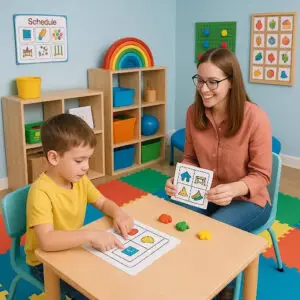
Many children also benefit from speech therapy to build communication, and from occupational therapy for sensory and daily-living skills. These often work best alongside one another.
Insurance and Services: Using the Right Terms
This is the one place where the wording genuinely matters. When you are dealing with insurers, school districts, or state programs, use the clinical language that appears on the report:
- Write “autism spectrum disorder” rather than autism on forms.
- Include the ICD-10 code 0 where a diagnosis code is requested.
- Include the support level if the report lists one.
- Keep copies of any report that lists F84.0, since it is often what unlocks therapy coverage and school accommodations.
Matching the paperwork to the report reduces back-and-forth and delays. If you have more questions about the process, our autism FAQs cover what families ask most.
Moving Forward: Your Next Steps After Understanding ASD vs. Autism
Understanding the terminology is a small piece of a much bigger picture. What tends to help most is learning how your child communicates, celebrating what they are good at, and finding a team that sees them as an individual. A diagnosis is a starting point for support, not a ceiling on what your child can do.
Building Your Support Team with Confidence
Most families end up working with a mix of professionals, which may include a pediatrician, a BCBA, a speech-language pathologist, an occupational therapist, and their child’s teachers. Look for providers who explain their reasoning, share progress openly, and treat you as part of the team.
Ready to Take the Next Step?
At Bierman Autism Centers, we pair evidence-based ABA with play-based learning so children build skills in an environment that feels joyful. With a 1:1 therapist-to-child ratio, every child gets focused attention, and we work closely with families so progress carries over to home and community. Across 30+ centers in 7 states, our teams have supported 375+ successful graduations and more than 1,000,000 mastered goals.
Every child grows at their own pace. Learn how our ABA therapy supports children at all support levels.
Frequently Asked Questions
Are ASD and autism the same thing? Yes. ASD and autism refer to the same diagnosis. Autism spectrum disorder (ASD) is the official medical term used in diagnoses today, and autism is the everyday shorthand most people use. Both are correct.
Why did the terminology change to Autism Spectrum Disorder? In 2013, the American Psychiatric Association combined several separate diagnoses, including Asperger’s syndrome and PDD-NOS, into one diagnosis: autism spectrum disorder. The change reduced confusion and reflected that autism varies widely between individuals.
Is Asperger’s syndrome still a diagnosis? No. Asperger’s syndrome is no longer a separate diagnosis. Since 2013 it has been classified as Level 1 autism spectrum disorder, meaning autism that requires the least support. People diagnosed before 2013 may still use the term.
What does “spectrum” mean in ASD? Spectrum means autism looks different in every person. It describes a wide range of strengths, challenges, and support needs, which is why two children with the same diagnosis can seem very different.
Which term should I use for my child? Both are correct. Your child’s paperwork will usually say “ASD” or “autism spectrum disorder,” but saying “autism” in everyday conversation is perfectly fine and often easier for family and teachers to understand.
What is the diagnosis code for autism? The ICD-10 code for autism spectrum disorder is F84.0. You will see it on diagnostic reports and insurance paperwork. Keep copies of any report that lists this code for services and school support.