

A back-to-school routine works best when you start about four weeks before the first day and change one thing at a time. Because children with autism often rely on predictability, your goal is to make school feel known before it arrives, not to prepare for it in a single weekend. The nine routines that make this possible: shift your child’s sleep schedule, rebuild your morning routine as a visual schedule, write a social story, visit the school, practice the transition, pack a sensory plan, give the teacher a one-page profile, set up a predictable after-school landing, and expect week one to break the plan.
A peer-reviewed systematic review found that coordinated home-school communication and structured visual planning emerged as the highest-impact supports for smoother school starts across 42 studies. And if you are still weighing the readiness question itself, our guide on whether your child is ready for school covers it separately.
The countdown below turns that research into a week-by-week action plan you can start today.
What is autism back-to-school preparation?
Autism back-to-school preparation is a structured, gradual approach to helping your child transition from summer routines to the demands of a new school year. It replaces last-minute scrambling with a four-week countdown that introduces one change at a time.
The goal is simple: make school feel known before it arrives.
When | What to Do | Why It Helps |
Four weeks out or sooner | List what’s changing at school | Shows you exactly what to practice |
Four weeks out | Begin shifting sleep by 15 minutes | Gradual change avoids sleep disruption |
Two weeks out | Introduce the visual morning schedule | Repetition builds independence before day one |
Two weeks out | Visit the school and do a dry run | Familiar places reduce first-day anxiety |
First day | Follow the practiced routine exactly as closely as possible | Sameness signals safety on a big day |
First two weeks | Log two lines per day, then adjust | Data-driven tweaks prevent overreaction |
9 routines that make school feel known before it arrives
Before you start the countdown, write down what will be different about the new school environment and the expectations your child will face, in as much detail as you can. A new building, a new teacher, a longer day, lunch in a cafeteria: each change on that list is something you can practice gradually over several weeks instead of all at once on the first day.
1. If sleep and wake times are changing, shift them in 15-minute steps
A graduated bedtime shift means moving your child’s sleep and wake times in small increments rather than resetting the clock overnight. Start four weeks. If school means an earlier bedtime or wake-up, start four weeks before the first day: move bedtime and wake time 15 minutes earlier every two or three days.
If your child currently falls asleep at 9:00 p.m. and school demands a 7:00 a.m. wake-up, those small shifts add up without the meltdowns that come from a sudden hour-long change. Consistency matters more than speed here, so hold each new time for at least two nights before you nudge again.
Bierman’s guide to developing sleep routines goes deeper on making the shift stick.
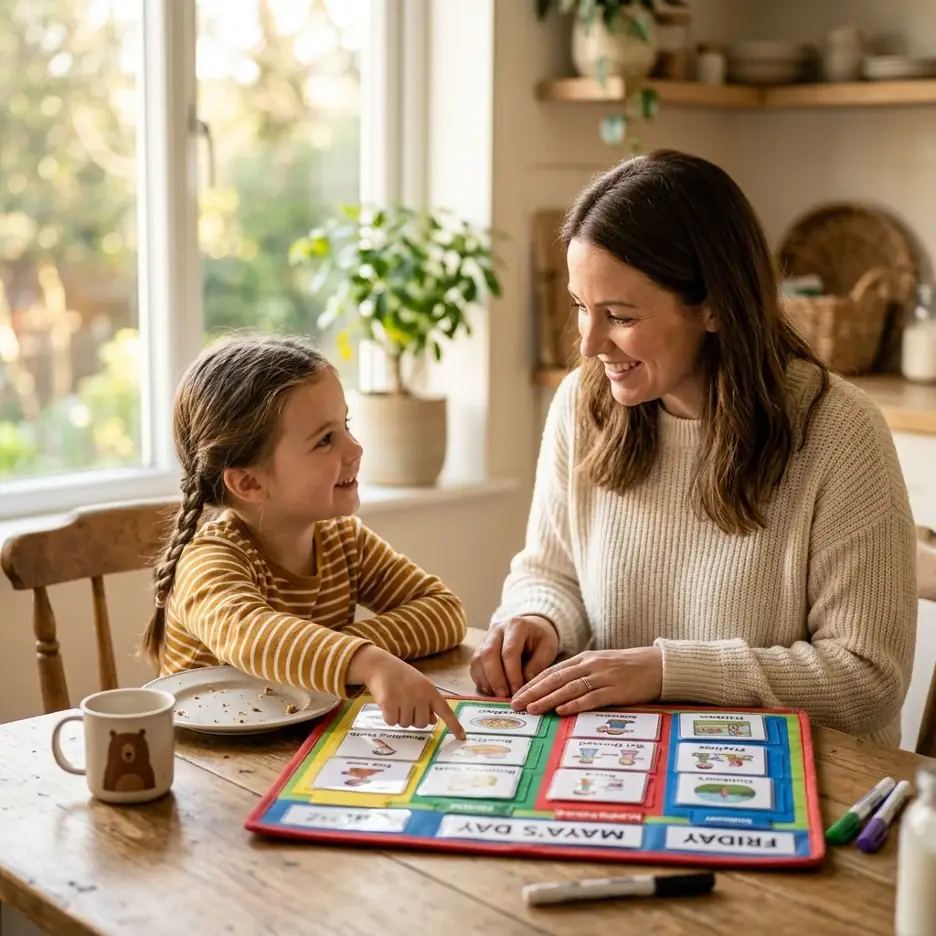
2. Rebuild the morning routine as a visual schedule
A photo-based morning schedule turns an abstract sequence into something your child can see and follow independently. Line up pictures of each step in order: shoes on, backpack zipped, snack in bag, out the door.
Post it at your child’s eye level and walk through it together every morning for at least two weeks before school starts. The repetition matters more than the design. Once your child can move through the sequence without prompting, the schedule has done its job.
For more on setting up visual schedules, Bierman’s resource walks through the broader framework.
3. Write a social story about the first day
A social story is a short, personalized narrative that describes an upcoming situation using simple sentences and a calm tone. Write one for the first day using details your child can hold onto:
- “My teacher’s name is [name]. They will meet me at the classroom door.”
- “The bus stops at the corner of our street. I will wait with [caregiver’s name].”
- “At the end of the day, [caregiver’s name] picks me up at the front door of the school.”front door of the school, the same way I got picked up at [last school or program].”
Include a few things that are staying the same from your child’s last school, classroom, or program. Familiar details help anchor the new ones and give your child a sense of stability.
Read it together once a day during the final week. The goal is for the first day to feel like a re-run, not a premiere.
4. Visit the school before the first day
Walking through the actual building replaces imagined unknowns with concrete memories. Plan two visits if the school allows it: one when the building is empty and quiet so your child can explore without sensory overload, and one when the classroom is open so they can meet the teacher and see their desk.
Bring your phone. Photograph the entrance, the classroom, the cafeteria, and the bathroom. Those images feed directly into the social story and give your child a reference point they can revisit at home whenever anxiety spikes.
Make the first visit at least two weeks before school starts so you have time to work through any barriers you spot. Look for routines that will be new for your child, like carrying a lunch tray in the cafeteria or using a drinking fountain in the hallway, and add them to the social story or break them into steps on the visual schedule.
5. Practice the transition, not only the destination
What if your child handles the classroom fine once they arrive but struggles with the chain of events that starts at your front door? Run three dry runs of the actual morning: real clothes, real time, real route. End at the bus stop or the car line.
Don’t go inside the school. The point is to make the hardest part of the morning (leaving home) feel automatic.
University of Washington research on classroom transitions confirms that explicitly teaching and rehearsing each transition step helps students navigate daily schedule changes with confidence.
6. Pack a sensory plan, not only a backpack
A sensory plan is a short list of tools and strategies that help your child regulate their body during the school day. It goes beyond supplies. Pack noise-reducing headphones, a chew or fidget the school has approved, and a change of clothes in case textures become overwhelming.
The most important item on the list is a named calm-down spot you agree upon with the teacher before the first day. Your child needs to know exactly where they can go and what they can do when the cafeteria gets loud, or the hallway feels like too much. Coordinate the whole plan, not only the calm-down spot, with the teacher and school staff before the first day so everyone supports your child the same way.
Bierman’s occupational therapy services help families build these plans with a therapist who understands your child’s sensory profile. For more ideas, explore these sensory-friendly back-to-school activities.
7. Give the teacher a one-page profile
A one-page profile is a single document that tells the teacher who your child is and how to support them, without requiring anyone to read a 30-page evaluation. Include four things:
- How your child communicates (spoken words, AAC device, or gestures)
- What helps (a quiet warning before transitions, a preferred seat, access to a fidget)
- What escalates distress (unexpected schedule changes, being called on without warning)
- What your child is great at (strengths the teacher can build on, including ways your child might lead, to build confidence and belonging)
- Who to call if your child needs support beyond the classroom
Hand it to the teacher at least a week before school starts.
Bierman’s guide to creating an autism-friendly classroom is a companion resource you can share alongside the profile.
8. Set up a predictable after-school landing
Decompression time is the bridge between a high-demand school day and the rest of your evening. Children with autism often spend their entire regulatory budget at school, and they need a predictable, low-demand transition when they walk through your door.
Keep it simple and identical every day: same snack, same 20 minutes of a preferred activity, no questions about the school day until after. That last part is hard for parents who want to know how things went.
But asking “How was school?” the moment your child walks in may feel like too much after a demanding day and can make conversation harder. Wait. The details will come later, on their terms.
9. Expect week one to break the plan, and adjust after it
Revise your routines with data, not on the first hard day. A rough Monday does not mean your plan failed. It means you have one data point.
Keep a two-line note each evening for the first full week. Write what went well and what didn’t. After five days, look for patterns.
If mornings consistently fall apart at the shoe step, that’s where you change one thing. Maybe you need to place the shoes by the door the night before. Maybe your visual schedule needs a “shoes” photo that’s bigger and more prominent. One adjustment at a time, just like the countdown that got you here.
Back-to-school checklist for children with autism
- Four weeks out or sooner: write down what will change about the new school environment and expectations.
- Four weeks out: begin shifting the sleep schedule in 15-minute steps.
- Two weeks out: rebuild the morning routine as a visual schedule.
- Two weeks out: write a social story about the first day.
- Two weeks out: visit the school before the first day.
- One week out: practice the transition, not only the destination.
- One week out: pack a sensory plan, not only a backpack.
- One week out: give the teacher a one-page profile.
- First day: set up a predictable after-school landing.
- First two weeks: expect the plan to break, log daily notes, and adjust one thing.
Want help building these routines for your child specifically? A Bierman team can work on school transitions during the first weeks of the year. Find a center near you.
How a therapy team supports a school transition
An ABA team helps your child practice the specific routines that matter most, like following a visual schedule independently and responding to new adult instructions. They can rehearse school-day sequences in a structured environment weeks before school starts.
A speech-language pathologist prepares your child to express their needs in the classroom, whether that means practicing verbal requests, programming relevant phrases into an AAC device, or rehearsing how to ask for a break.
An occupational therapist builds the sensory plan described above and works with your child on tolerating school-specific demands like sitting in a hard chair and managing a noisy hallway. Together, this team turns your August preparation into September confidence. You can see how Bierman clinicians teach this approach in the free caregiver webinar Routines That Empower: Help Your Child Thrive With Visuals, part of Bierman’s caregiver training resources.
Start the countdown now, not the night before
Every one of these nine routines has the same underlying principle: children with autism can thrive in a supportive, play-based environment when school feels predictable before it arrives. Four weeks of small, deliberate changes beat one frantic weekend of preparation every time.
The checklist above gives you a week-by-week map. Your child’s responses during the first two weeks give you the data to refine it.
Does your child need more time to adjust to new sensory demands, or are you still searching for the right morning sequence? Families working with Bierman Autism Centers get this kind of structured transition support from a multidisciplinary team of BCBAs, speech-language pathologists, and occupational therapists across more than 30 centers in seven states. With over 400 successful graduations and more than 1,000,000 goals mastered, those teams know what it takes to help a child walk into a new classroom ready to learn. If the start of school has surfaced new concerns about your child’s development, a free developmental screening is a straightforward next step toward building the right plan together.
Frequently asked questions
How do I coordinate the back-to-school plan if my child splits time between two households?
Create one shared routine document and keep the sequence consistent in both homes, even if the timing differs. A brief weekly check-in between caregivers can help you align expectations and prevent your child from having to relearn rules in each environment.
What if the school will not allow a pre-start visit or classroom tour?
Ask for a few photos of key locations (entrance, classroom door, bathroom) and a simple map, then practice the route visually at home. You can also request a short meet-and-greet by phone or video so your child can connect a face and voice to the new environment. Ask for a written schedule of what a typical day looks like, too, so you can preview it together at home.
How can I prepare a child who uses AAC for new classroom communication demands?
Update the device with school-specific vocabulary like help, break, bathroom, and names of staff members, then practice using those phrases in short role-plays. Share the AAC basics with the teacher so they know how to honor requests quickly and consistently.
What should I do if my child refuses the visual schedule or rips it down?
Start with a single-step schedule for the most predictable moment of the day, then build gradually as tolerance improves. Consider using sturdier materials (laminated cards, Velcro) and offer your child a small choice (which card to place first) to increase buy-in.
How do I handle medication timing or appetite changes once school starts?
Plan for a short adjustment period and track sleep, appetite, and behavior so you can spot patterns without guessing. If changes persist, coordinate with your prescriber and the school nurse to confirm dosing times and any needed accommodations for snacks or hydration.
What is the best way to communicate with the school if my child cannot reliably report their day?
Set up a simple daily check-in system such as a short form, a shared communication app, or a brief end-of-day note with one highlight and one challenge. Clear prompts make it easier for staff to respond consistently and help you support skills at home without interrogating your child.